

The Russian aggression of Ukraine is a major geopolitical event, a dislocation of the global framework on which the dominant world powers settled in the years following Word War II
Reminiscent of Russia's ten-year fruitless engagement in Afghanistan, against the heavily US-supported Mujahedeen, but fast-tracked, and playing-out in real time on every screen in the world, a repeat of that dismal failure could weaken the regime beyond recall
Given the magnitude of the events unfurling on the battlefield and in diplomatic circles, a neutral stance might remain an option for minor players, but not for the global powers, India or China, and not even for regional powerbrokers, such as Turkey or Brazil
Geopolitical tumult is reminiscent of the sucking sound of a giant whirlpool, drawing in reluctant partners compelled to take the plunge in developments which had appeared incidental to their national interests
Only they were not
The dislocation undermined a network of compromises, dubious as concessions usually are, but bridging incompatible social and political systems and creating a sense of permanence
Nowhere has the tremor been more destructive than in Europe
As the smoke dissipates, the tenets of European compromise in the post-Cold War era are laid bare
Dating from 1970’s, the Ostpolitik, a barter agreement delivering gas to Europe traded for technological know-how and equipment in Russia, asserted common economic interest as bedrock of steadfast dialogue, even in times of political disarray
With the 50-year-old understanding in shambles, and all the business ventures engaged in its wake in abeyance, European powers have to grapple for a new role and the continent’s largest economy, most engaged and most dependent on Russia’s energy exports, cannot play second-fiddle
Germany is on edge…
In effect, a defensive war is waged by Ukraine with Western 21st century logistical support, confronting an invader who relies on offensive tactics out of the 20th century rulebook
America at war 2.0
Asymetric warfare suits the U.S. well
American engagement in support of Ukraine’s defense is reminiscent of the unstinting support delivered to the USSR's enemies' in Afghanistan, a 10-year ordeal for the combatants
However, while the overall strategy is similar, execution points to deep generational transformations
- speed - delivered overnight in Poland by the U.S. Air Force, weapons are said to reach the frontline within 48 hours
- technology - gaining in precision, defensive weaponry has benefitted from technological advance, putting their efficiency on par with offensive battlefield tactics
- information - going unmentioned in reports, advanced weaponry is intimately integrated with the flow of data collected in the field
- cybersecurity - defensive as well as offensive, cyberattacks are vaunted on occasion, and probably a day-to-day fixture
Political pronouncements have been backed by large, and increasing, volumes of weapon deliveries, making good on the promises
The massive American shipments estimated at $ 1.15 billion in late March, were already out of date…running up to $1.7 billion for expedited shipments and an additional $800 million in the planning stages
Are making their way to Ukraine 11 Mi-17 Soviet-designed helicopters — originally budgeted for Afghanistan — 18 155 mm Howitzer cannons, 600 AeroVironment Switchblade drones, an undisclosed number of AeroVironment Puma drones, which can circle for hours above a battlefield and help soldiers direct the Switchblades, as well as 5,500 shoulder-launched Javelin missile systems for attacking armored vehicles, 200 armored personnel carriers, 40,000 artillery shells, and protective suits and individual detection devices to be used in the event of chemical, biological, radiological or nuclear attacks
Searching for an exit strategy
By publicly acknowledging the magnitude of its logistical support, the U.S. may be intent on signaling to Russia that the war cannot be won
The more effective the Western, essentially but not only American, support, the more predictable the stalemate, with heavy human losses on both sides
This tactical choice remains a cliff-hanger
To stem the flow of Western weaponry, Russia may well go beyond its recently issued formal complaint, by proceeding with systematic assaults on Ukraine's civilian population, effectively confronting the U.S. with an unenviable choice, either to raise the stakes again or to backdown
To be relevant for the different parties to the conflict, the balance must shift, either on the battlefield or by diplomatic outreach…
None of the options are palatable
On the battlefield, the destructive power of Russia’s city bombings will be unleashed to break the stalemate, and will be countered by the most advanced defensive technology and intelligence…
Diplomatic outreach is of little consequence as long as sanctions induce a slow-bleed, dismissed out of hand, and not a cardiac arrest of Russia's economy
Something has to give and it is decision time for Germany, backed by the European Union
Germany's gambit
A gambit is a chess opening in which a player sacrifices material with the aim of achieving a subsequent positional advantage
Europe has the most to lose in a conflict festering on its borders
Wanton destruction and unspeakable human suffering are dark reminders of a not-so distant past, a memorial looming over European governments
America's 'heartland' cannot be expected to share in this emotional bonding, nor might China, with its own turbulent recent history, partake in the tragedy...
Europe however has once again to confront her devils, and none more so than Germany
Throwing its full weight behind economic development which served it so well in its rise as Europe's premier power, Germany rode the mutually beneficial energy bridge for all it was worth
Boosting its power-hungry petrochemical, aluminum and steel conglomerates with access to Russian fossil fuels, Germany's energy majors transferred the equipment, the technology, the expertise and the cash to their Russian counterparts as budding cooperation blossomed into full partnerships
Over time, as the wealth generated in Russia by energy exports grew exponentially, the corruption generated by such vast riches was dismissed heedlessly as a domestic affair...perhaps even as an insurance to keep the ball rolling...
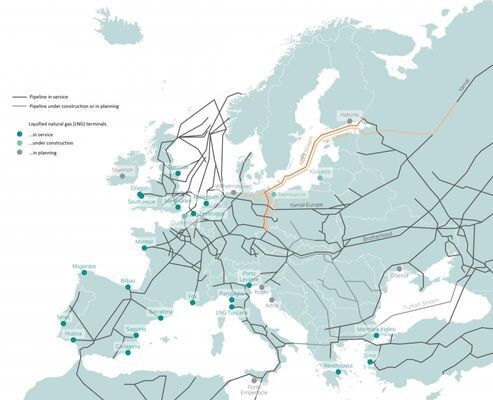
Stitching Europe, from Denmark to Italy, in one energy-hungry market, the pipelines seemed to provide material proof of a resilient relationship with Russia's gas exporter
Until it was not...
Seeking leverage
The Kremlin may have calculated that its territorial ambitions could strain - but not break - the mutual dependency
Russia's gamble on a short 'operation' in Ukraine, to be presented to the West as 'fait accompli', obviously did not live up to expectations
Possibly worse, in the Russian regime's perspective, is the medium drag on gas exports, as contributors to the federal budget, even with much higher prices balancing in part the loss in volume
While oil is 'fungible', transported by a vast flotilla of tankers and commanding world market prices, the gas markets are more segmented, relying critically on transport, and alternative delivery options are not as forthcoming
Egged on by Europe's top gas prices, low-cost provider Gazprom, with its pipeline network almost exclusively directed to its large Western markets, felt secure in the best of all possible worlds...
...until the war left Russia - and Gazprom - with no escape route at all to replace Europe's large export volumes, in the coming three-to-five years...if not many more
President Putin had been engaged in a power struggle with Gazprom for over a decade to diversify gas transport options
Mr. Putin was aiming sensibly at more pipelines serving China and Asia (only one, with a capacity of 38 bcm, was inaugurated in December '19) and, significantly, he was giving priority to export of LNG - Liquid Natural Gas
Lacking the technological expertise of regasification terminals, and led by a powerful clan of pipeline experts, Gazprom did very much not favor LNG ....
Pushing hard, the Russian President dented Gazprom's export monopoly by supporting competitor Novatek in the build-up of LNG shipments
In 2021, amounting to 8% of global LNG supply, LNG shipments reached 16% of total Russian gas exports- 210 bcm by pipeline and 40 bcm by LNG - bcm stands for billion cube meters
In the European perspective, Germany's reliance on Russian gas matters most as the largest gas importer (82 bcm per year - 49% Russia sourced), followed by Italy (64 bcm - 46% Russia sourced)
With 45% of total European Russian gas imports between Germany and Italy alone, Europe's dependency rate is further boosted by the countries abutting Russia's borders (the Baltics, Finland and the Balkan States), all close to 100% reliant on Russia
Russia has been late in executing an export diversification for its gas, as it was becoming clear that Europe's market potential was constrained by "renewable energy" policies and a maturing industrial backbone
As profitable as the Western market has been, compared to the more costly approach to the Asian countries, an allocation of 65% of its exports to Europe's slow-growth, and potentially falling, demand has been poorly devised, from the Russian perspective
Dependent on cheap Russian gas to keep its industrial edge, Germany for ist part has been reluctant to question tried-and-true assumptions about their gas partnership
Refusing steadfastly to diversify because of cost considerations of LNG shipments from the U.S. or Qatar, and in fact, doubling down with the Nord Stream 2 pipeline's additional capacity (55 bcm),
Germany will be reaping the bitter fruits of lazy thinking - very expensive energy and constrained gas volumes
The horse-collar tackle
... a defender tackles another player by grabbing the back collar or the back-inside of an opponent's shoulder pads and pulling the ball carrier directly downward violently in order to pull his feet from underneath him, says Wikipedia
This American football maneuver may fit just right in, since American gas exports come out as the great beneficiaries of Russia's Ukrainian war
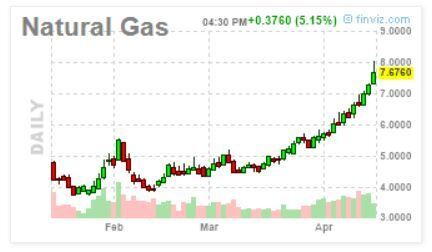
Of Russia or of Germany, who will be pulled down 'violently', in a back collar grab ?
Quite apart of the human tragedy perpetrated in Ukraine, what will the price of economic complacency be, for Germany and for Russia...?
Following a series of major injuries, the horse-collar tackle was banned after 2008 by the NFL and in college football